Social Profiles

Join The Community

Premium WordPress Themes

Showing posts with label Bangladesh. Show all posts

Saturday, October 1, 2011

Powerplay tweaks and end of runners


Three's a crowd: there will be no more
runners allowed in international cricket
West Indies' tour of Bangladesh, which begins with a Twenty20 on October 11, will be the first international series under the ICC's revised playing conditions, which are effective from October 1. The amendments are only applicable to international cricket.
The ICC's cricket committee had made the recommendations after its meeting in London in May and they were passed by the executive board at the annual general meeting in Hong Kong in June.
Powerplays (ODIs only)
In a full ODI, the teams can take the bowling and batting Powerplays (five overs each) at the start of an over after 15 overs of an innings have been bowled. They must complete the Powerplays by the 40th over, which means the last block of fielding restrictions must begin in the 36th over. The first ten overs will comprise the mandatory Powerplay. This condition will not apply to innings reduced to fewer than 40 overs.
Under the previous playing conditions, teams were allowed to take the bowling and batting Powerplays at any time after the completion of the tenth over of the innings.
Runners (All formats)
A batsman will not be allowed a runner under any circumstances. The batsman can retire hurt and return to bat at a later stage in the innings.
Two new balls per innings (ODIs only)
Each fielding team will be given two new balls to be used in alternate overs, one at each end. The mandatory change of the ball after the 34th over of an innings will not take place anymore.
Obstructing the field (All formats)
If a fielding team appeals and the umpire feels the batsman has significantly changed his direction without probable cause, while running between the wickets, and obstructed an attempt to run him out, the umpire can give the batsman out for obstructing the field. It is not relevant whether a run out would have been affected or not. The on-field umpires are allowed to consult the third umpire in making the decision. The other circumstances in which a batsman can be out obstructing the field are still applicable.
Penalty time (All formats)
This amendment refers to the calculation of the time for which a player cannot bat or bowl because he or she was off the field.
If a player, who still has some unexpired penalty time remaining from a previous absence, is on the field when play is interrupted by bad weather, light or other reasons, the duration of the stoppage will be deducted from the remaining penalty time.
Bowler attempting to run out a non-striker before delivery (All formats)
Previously, the bowler could run out a non-striker backing up only if he did so before entering his delivery stride. This meant that as the bowler's back foot landed, the non-striker could move down the pitch before the bowler delivered the ball.
According to a new playing condition, 42.11, "The bowler is permitted, before releasing the ball and provided he has not completed his usual delivery swing, to attempt to run out the non-striker. Whether the attempt is successful or not, the ball shall not count as one of the over. If the bowler fails in an attempt to run out the non-striker, the umpire shall call and signal dead ball as soon as possible."
The umpires shall deem the bowler to have completed his delivery swing once his bowling arm passes the normal point of ball release.
Extra time to complete a match (Tests only)
According to clause 16.2.2 of the Test match playing conditions: "The umpires may decide to play 15 minutes (a minimum of four overs) extra time at the scheduled lunch or tea interval of any day if requested by either captain if, in the umpires' opinion, it would bring about a definite result in that session. If the umpires do not believe a result can be achieved no extra time shall be allowed.
"If it is decided to play such extra time, the whole period shall be played out even though the possibility of finishing the match may have disappeared before the full period has expired.
"Only the actual amount of playing time up to the maximum 15 minutes extra time by which play is extended on any day shall be deducted from the total number of hours of play remaining, and the following session of play shall be reduced by the amount of time by which play was previously extended under this clause."
Delay of lunch interval when nine wickets down (Tests only)
If a team is nine wickets down at the time of the lunch interval, the break will be delayed by a maximum of 30 minutes. Previously, only tea was delay-able, while lunch was taken even if a team was nine down.
Duration of interval between innings (ODIs only)
The minimum interval for an uninterrupted ODI match has been increased from 20 minutes to 30 minutes.

Saturday, September 3, 2011

I've lost nine kilos from not eating - Meth

Keegan Meth: "At first, I didn't know where it had hit me.
But then, I looked down and saw blood, and I could hear
someone saying, 'Here's one of his teeth'."

Two days after Keegan Meth had four teeth knocked out in the fifth ODI against Bangladesh on August 21, he logged onto his Facebook account. He had 380 friend requests and they were all from Bangladeshis who were concerned after Nasir Hossain had hit the last delivery of the innings straight back at Meth, who, in his follow through, copped it in the mouth.
"That ball could have gone anywhere on the field, but it picked my mouth," said Meth during the second day of the lone Test between Zimbabwe and Pakistan in Bulawayo. "I wouldn't wish this on my worst enemy, but it's part of the game and I just have to think of a way to get over it."
The 18 stitches Meth had on the inside of his mouth were removed on Friday, but it will still be weeks before he can have the necessary surgery to replace the teeth. "We have to wait for my lip to heal and then the implants can be put in," he said. "But I started training today - running and that sort of thing."
It may seem too soon for Meth to be back on the park, but he wants to move past the incident as soon as possible. He shows no hesitation when talking about it. He can recount most of it fluently and does not blame himself, or anyone else, for the accident. "I just didn't pick up where the ball went and then, at first, didn't know where it had hit me. But then, I looked down and saw blood, and I could hear someone saying, 'Here's one of his teeth'. The fourth umpire on the radio said I was bleeding on the pitch and had to get off."
Meth was taken to hospital, where he got stitches, and returned to the ground later that day although he did not bat. The teeth he lost were at the front of his mouth and it resulted in him not being able to eat for five days, surviving on liquids. "I've lost nine kilograms from not eating, so I have to work to get some of that back." He is now able to get solid food to the back of his mouth and chew from there.
It's a massive setback for a young man who was trying to cement a spot in the national team and Meth is down that he will play no part in the ongoing series against Pakistan. Elton Chigumbura's knee injury meant that the allrounder's spot was up for grabs in the Test, a role that Meth could have filled. "I'm very disappointed, especially because I missed out on the first Test and I thought I had done enough to play there," he said. "But I can't be too upset, this was a freak accident and I'm going to try and be ready for the New Zealand [Test] series in November."
Meth says he is "not too bothered" that he may always be known as the man who got hit in the mouth and is quite proud that the YouTube video of the incident has been viewed almost 180,000 times so far. "I actually want to say thank you to everyone who has sent me messages, there's been a lot of concern shown for me."
Queens Sports Club, Meth's home ground, has been a snakepit for the allrounder in recent times. Earlier this year, he had a head collision with Bradley Staddon in a Logan Cup match when both men were going for a high catch. Meth was concussed and out of the game for a week. "Yes," he said, "My home ground has been a bit of shocker."

Tuesday, August 9, 2011

Zimbabwe triumphant on Test return

Brendan Taylor was adjudged Man of the Match
for his century, after leading Zimbabwe to
a memorable win
A dominant all-round performance by Zimbabwe, capped by their bowlers slicing through the Bangladesh line-up on the fifth day saw them win their comeback Test, after an almost six-year exile from the format. It took just 15 balls after lunch for Zimbabwe to complete their victory after a near flawless morning session from the bowlers. Brian Vitori and Kyle Jarvis created the pressure upfront, leaving the Bangladesh line-up ripe for the picking for Chris Mpofu and Elton Chigumbura.

Bangladesh's batsmen had a tough, but doable, task on a pitch that has not deteriorated and remained good for batting, needing 263 runs with seven wickets in hand at the start of the day. Instead of applying themselves with patience and planning, though, they played a clutch of careless shots, especially as it became evident that their challenge was dissipating. Abdur Razzak's 43-run cameo added a little bit of sunshine to an otherwise dark performance that mirrored their first innings display in terms of execution.


Zimbabwe had done the bulk of their hard labour in the four days preceding the final one, with centuries from two of their stalwart batsmen, Hamilton Masakadza and Brendan Taylor. But, it was the new-ball pair of Brian Vitori and Kyle Jarvis who impressed most, especially after being labelled "ordinary" by a confident Tamim Iqbal at the end of day four and they exacted their revenge early on the fifth. Vitori began by demonstrating that he could move the ball into the right-handers as well, while Jarvis bowled with brisk pace and variety, mixing up his full, short and slower balls.


Mohammad Ashraful was up to the task, at least initially. He left well and took advantage of anything overpitched. He batted with the same calm that he had employed in his first innings and was also doing a fine job of marshalling his partner, Mushfiqur Rahim, who showed composed judgment.


Vitori continued plugging away, getting some balls to move away, others to hold their line and after several overs of nagging length, Ashraful could take no more. He tried to push a delivery away but it jagged in late and took the inside edge onto the stumps. With that dismissal, Bangladesh were rattled and Zimbabwe fired up.


Vitori followed Ashraful's wicket with a superb over, beating Mahmudullah's bat twice. The danger for Zimbabwe came when the opening pair was replaced but Mpofu and Chigumbura did not let up. Mpofu varied his lengths while Chigumbura put on an impressive display, bowling as many slower balls as possible.


Mahmudullah was determined to cash in where he could but his over-eagerness started a mini-collapse, during which Bangladesh lost three wickets in 12 balls for seven runs. He tried to cut without any foot movement and was caught behind. Five balls later Shakib Al Hasan, who also played irresponsibly, went to a sharp catch from Taylor at second slip after pushing at a length ball, and then Mushfiqur Rahim's more careful knock ended when he flicked a ball to square leg.


Zimbabwe could smell blood but instead of tracking it down with a killer instinct, they relaxed a little and allowed Abdur Razzak to have some fun. He smoked five fours off a Mpofu over and three sixes off Ray Price, two of them slog sweeps. The cameo ended when Chigumbura, from around the wicket, broke through his defence and bowled him.


Bangladesh had little to hope for after that and their misery ended inside three overs after lunch. Jarvis struck with the first ball, bowling Shafiul with a length ball that pitched on middle and held its line. With just one more wicket to get, Zimbabwe put in six slips for Robiul Islam, who survived a confident lbw shout first up.
He defied the field placing with two fours on the leg side, but was never going to last for any length of time. Jarvis claimed his fourth wicket of the innings, trapping Robiul lbw with a ball that jagged in and hit him on the front pad. As umpire Kumar Dharmasena raised his finger, Zimbabwe's players immediately formed a huddle, a collective show of unity to mark their victorious return to the Test fold.

Tuesday, April 12, 2011

Bangladesh hope to regain some pride

Saturday, February 19, 2011

Sehwag and Kohli sink Bangladesh in opener

There was no reprise of the 2007 upset at Port of Spain in the opening game of this World Cup. Instead, Virender Sehwag and Virat Kohli gave evidence of the havoc this Indian batting line-up can create during centuries that demoralised Bangladesh's bowlers. Shakib Al Hasan's men failed to maintain their composure in the grandest match of their lives and conceded a total beyond the reach of their batting abilities.
There was wisdom in Bangladesh choosing to chase - the previous 12 day-night matches at the Shere Bangla were won by the team batting second - but their bowlers were wayward on a slow pitch that kept low and had loopy bounce not conducive to shot-making. Shakib wanted to keep India below 260 when he put them in because of the dew factor later in the evening. He watched the target surge past that as Sehwag and Kohli, who justified his captain's decision to leave out Suresh Raina, dismantled the attack in front of a shell-shocked crowd and powered India to 370.
Bangladesh, however, did not go quietly. Faced with an impossible chase, Imrul Kayes attacked from the outset after which Tamim Iqbal and Shakib took charge. They set off at a sprint, swinging fearlessly, edging luckily, and brought cheer to their supporters. What Bangladesh failed to do, though, was sustain the aggression for as long as Sehwag did, and the asking-rate soared irreversibly out of reach.
With a withering back-foot drive, Sehwag had slammed the first ball of the tournament to the cover boundary, the opening move of his maiden century against Bangladesh silencing a boisterous Mirpur crowd. Shafiul Islam had given Sehwag too much width, and in his second over he strayed twice on to Sachin Tendulkar's pads with dire consequences. His day would not get better and he conceded 69 off seven.
India raced to 36 after four overs, forcing Shakib to turn to his premier spinner, Abdur Razzak, in the fifth. Razzak looped the ball into Sehwag from round the wicket, following the batsman and cramping him for room as he tried to hit inside out through the off side. Sehwag had scored 12 off his first six balls and 13 off his next 24.
Bangladesh were listless, though, as Sehwag regained his touch and never lost it again, but they also had some good fortune. A mix-up, during which both Tendulkar and Sehwag were ball-watching, left both batsmen at one end and the Mirpur crowd found its voice again.
Sehwag, however, continued piercing gaps and hit the tournament's first six, hoisting Razzak over wide long-on to reach fifty off 45 balls. With Gautam Gambhir, Sehwag added 83 to build on the opening stand of 69. While Sehwag used muscle, Gambhir played with precision - dabbing, pushing and chipping into gaps. His dismissal for a run-a-ball 39, bowled by a straight one from Mahmudullah, was against the run of play.
The exceptional feature of Kohli's innings was his driving. On a surface this slow, he reached the pitch of the ball, gathering momentum with a forward thrust of his body, and drove crisply through the off side with a whip of his wrists. He did it against pace and spin, scoring effortlessly at more than a run a ball. In the 33rd over, Kohli drove Naeem Islam twice to the cover boundary and pulled him behind square, placing the ball just wide of the fielders each time. India took their batting Powerplay after the mandatory ball change and scored 48 for 0 during the fielding restrictions.
At one stage Sehwag, who had Gambhir running for him because of an injury, had a shot at a double-century. He fell in the 48th over, though, almost making good his pledge to bat through the innings. Kohli continued to motor towards a hundred in his first World Cup match and got there off the penultimate ball of the innings, possibly having secured his spot for the rest of the tournament.
The pitch quickened in the evening, making shot-making easier, and the dew greased the outfield, making the ball harder to grip. But Bangladesh's bowlers had conceded too much ground for their batsmen to regain. They tried, though, and the initial assault on the Indian bowlers was fierce.
The highlight of that brief blitz was the attack on Sreesanth. Kayes edged, flicked, pulled and drove him for boundaries, and a wayward wide contributed to Bangladesh taking 24 runs off the fifth over. They were 51 for 0. Kayes then tried to force the slower pace of Munaf Patel, who replaced Sreesanth, through the off side and played on, ending the opening partnership at 56.
Zaheer Khan's control and the introduction of spin resulted in an increase in dot balls and a reduction in boundaries, and by the half-way stage the asking-rate was already 9.36. Tamim and Shakib completed aggressive half-centuries and the rest of the batsmen also struck the ball fluently during a heartening display. Victory, however, had already escaped them. Bangladesh will hope to reproduce this batting effort in a match in which their bowlers get their act together.

Passionate Bangladesh provides perfect opening


Those who were not at the Bangabandhu National Stadium will never know just how successful and moving the opening ceremony of the 2011 World Cup was. Those who saw it on TV would have cringed at Sonu Nigam crooning an English inspirational song, Bryan Adams of all people being the top draw, recordings of Shankar-Ehsan-Loy's unremarkable theme song playing on loop, and the politicians inducing yawns with their speeches.
Those who were here, though, saw, heard and felt the heartbeat of Bangladesh cricket. What happened inside the stadium, sold out by 25,000 people welcoming the World Cup with open arms, was only a minor part of it. There were 25,000 other fans - and this is a conservative estimate, mind you - outside the stadium, with no hope or intention of getting in, partying away to their own rhythm of vuvuzelas, carrying Bangladesh flags about 50 feet in length, celebrating the World Cup.
The reception for the World Cup on the streets of Dhaka was the closest cricket can get to a football World Cup. There was no giant screen outside for them, the music could hardly be heard there, there was obviously no alcohol to keep them going, but they danced and made merry, choreographing their own moves. There was not an inch of space in about a kilometre's radius of the Bangabandhu Stadium. Nigam, Adams, Mustafa Kamal (the BCB chief) might as well have not turned up. The crowd either side of the stadium wall couldn't care less.
There were journalists at the ceremony who have covered cricket World Cups, Olympics, Asian Games, even football World Cups, and they swore they have never seen anything like this before. For a sport that has a bad history with opening ceremonies, nothing could have been more welcome. It didn't need the Bangladesh prime minister Sheikh Hasina to declare the World Cup open. The World Cup was open when at 2am last night, thousands were dancing on the streets, signing the best-wishes bat, and tens of cars went round and round the Bangabandhu Stadium. And when similar scenes were taking place at the Shere Bangla National Stadium in Mirpur, which didn't even have anything to do with the opening ceremony.
And to say that the 50-over format is supposed to be dying. Not in the subcontinent, not in Bangladesh by a long shot. However, like with the good old ODIs, the opening ceremony had its middle overs. Nigam followed up his Celine Dion act from the recently held Filmfare Awards back home in India with a self-composed song titled Rise Up For Glory, which showed that his great voice needs to be rescued, from himself. The politicians took about half an hour of valuable time, and were on the verge of inviting a streaker. The crowd mimicked and made fun of one of them, another speaker gave two different figures for Bangladesh's population in half a minute, and ICC chief Sharad Pawar tried to speak Bangla but no one could make out a word of what he said.
In the bigger picture, though, all those were minor irritants. There were some very nice touches to the ceremony. Local artists performing before the main function started was one such; getting popular, almost legendary singers, Mumtaz, Sabina Yasmin and Runa Laila, to share the stage was another, as was the crowd going crazy at the first sound of Bollywood music in an overstretched celebration of India.
Then there was the laser show involving the towering 24-storey Bangladesh Development Bank Building . On a long white curtain, a cricket pitch was projected. From the top floor, men tied on harnesses came down. Two batsmen, bowler, keeper, slip, umpire, cover, midwicket were all there. One man was pulled up suggesting a bowler running in to bowl. The ball was a laser pointer. In one over of "aerial cricket", they showed a forward-defensive, an lbw appeal, a scrambled single and overthrows, a play-and-a-miss, and a boundary.
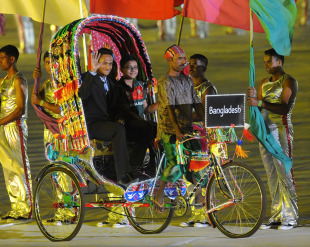
The best, and the most unforgettable, moment was when all the captains were brought in on cycle rickshaws. One captain on each rickshaw, with a young boy sitting beside him, waving to the crowd, and the crowd responding generously. They came out alphabetically, Australia first, with one exception - Bangladesh were saved for the last, and more importantly Shakib Al Hasan for the very last. Few present at the Bangabandhu Stadium will ever forget the applause that Shakib walked out to.
Put the applause for the other 13 captains together - and they were not stingy with any of them - but it paled in comparison. That noise was enough to know what the World Cup meant to the country. In that moment, the traffic jams, the poor singing, the long speeches didn't matter. Over to Shakib's team now to make sure the party goes on deep into the tournament. The people deserve it.